
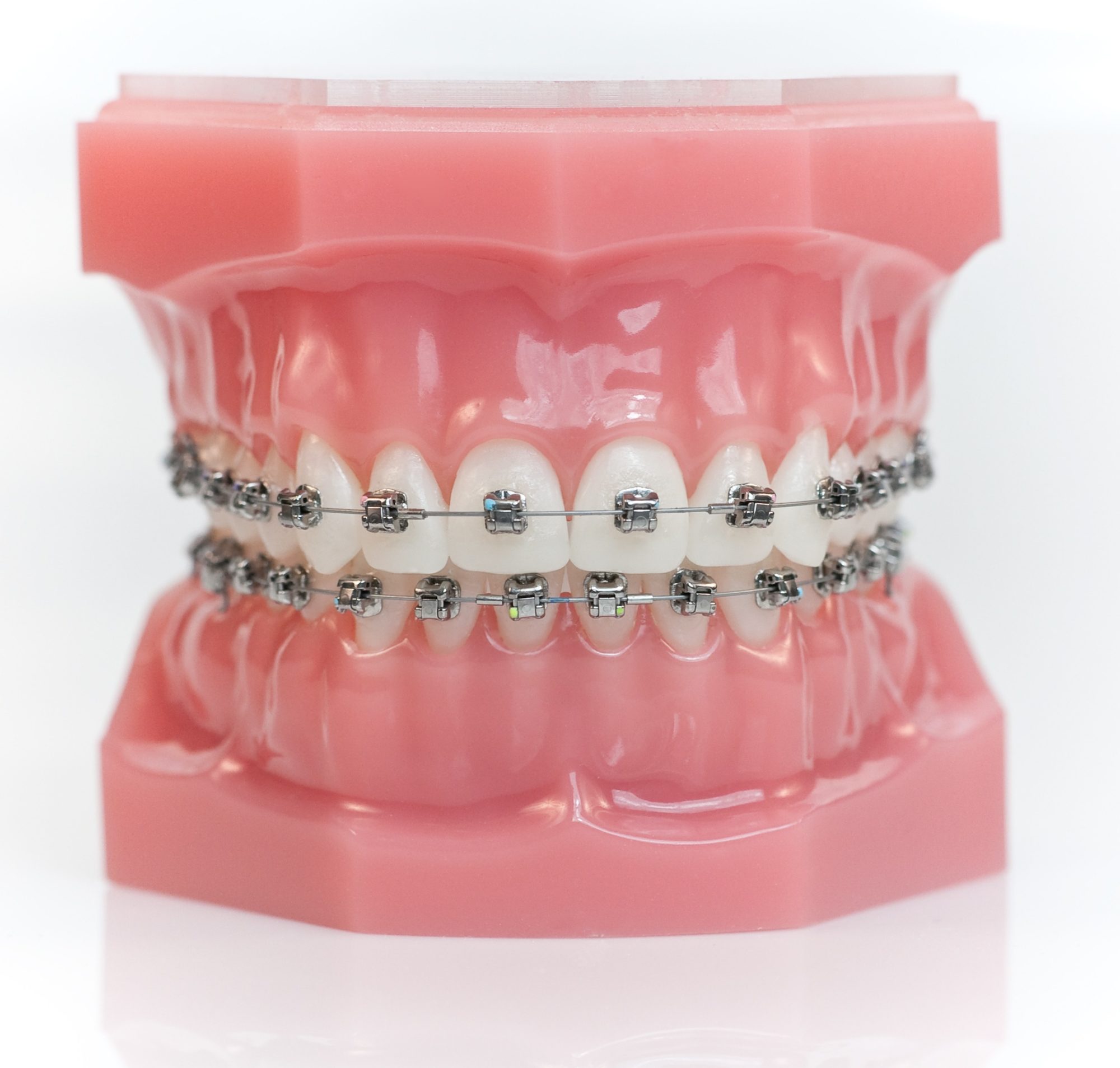
Most orthodontic patients do not need teeth removed. Extraction is considered when crowding, the bite or facial profile cannot be corrected by expansion, tooth reshaping or moving teeth back within the available bone.
Why would an orthodontist remove teeth at all?
Teeth have to fit within the bone that holds them. When there is more tooth than space, that space has to come from somewhere: widening the arch, using space at the back, making teeth slightly narrower, or removing a tooth. Extraction is the option used when the space needed is large or when the bite and profile would be harmed by pushing teeth outward.
Crowding
Severe crowding is the most common reason. Aligning crowded teeth requires arch space; without it, teeth end up tipped forward or pressed against thin bone and gum tissue.
Bite correction
Some bites need the upper and lower teeth to meet differently, not just look straighter. Space may be needed on one arch to let the other catch up.
Profile and lip support
Moving front teeth forward changes lip position. When teeth are already prominent, adding more forward movement works against both the bite and the profile.
What are the alternatives to pulling teeth?
| Approach | What it does | Typical fit |
|---|---|---|
| Palatal expander | Widens the upper arch using the growing midline suture | Children and adolescents still growing |
| Arch development with braces or aligners | Uses light forces to upright and align teeth within the bone | Mild to moderate crowding |
| Interproximal reduction | Removes a fraction of a millimeter of enamel between teeth | Small space needs, often with clear aligners |
| Using space at the back of the arch | Moves molars back to open room in front | Selected cases, often with appliances or attachments |
| Extraction | Removes a tooth to create substantial space | Severe crowding, protrusion, or bite limits |
In growing children, timing matters as much as technique. Our guide to palate expanders and our comparison of Phase 1 and Phase 2 treatment explain why some space problems are solved more easily before the adult teeth are all in.
How does an orthodontist decide?
Records come before the plan
The decision is made from a clinical exam, photos, a digital scan and x-rays that show root positions, jaw relationship and how much room actually exists. It is not made from how the teeth look in a mirror.
Space analysis
Your orthodontist measures how much space the teeth need versus how much the arch has. That number, together with your bite and profile, determines whether space can be created or has to be borrowed from a tooth.
Adults and children are different cases
Children have growth available, so widening and guiding eruption are realistic tools. Adult bone does not widen the same way, so adult plans rely more on tooth movement within the bone, enamel reduction or extraction. Our overview of adult orthodontic treatment covers those tradeoffs.
Which teeth are usually removed, and does it hurt?
Which teeth
When extraction is part of the plan, premolars are the usual choice because they sit where the space is most useful and are the least visible. Baby teeth are sometimes removed instead, to let a crowded adult tooth erupt into a better position.
What the appointment is like
Extractions are done with local anesthetic, usually by an oral surgeon or your general dentist, and braces or aligners are often placed before or shortly after so the space is used rather than left to collapse.
Do gaps stay?
No. The space is closed during treatment as teeth are moved into it. Closing it is part of the treatment time, which is one reason extraction cases can run longer – see our realistic treatment timelines.
What about wisdom teeth?
Wisdom teeth are a separate question from orthodontic space. They are monitored on x-rays and removed when they cannot erupt cleanly, are damaging neighboring teeth or cannot be kept clean. Removing them is not a substitute for retainer wear, and keeping them is not the reason a finished result shifts.
What does treatment look like when extractions are part of the plan?
Sequencing
A typical sequence is records and planning, then extraction, then appliances placed close to that time so the space is used rather than left to collapse. Sometimes braces go on first to prepare the teeth that will move into the space.
Closing the space
Space closure is done with controlled forces over months, moving the teeth behind or in front of the gap into it. This is the stage that determines whether the finished arch looks even, and it is the reason extraction cases usually require more visits.
Roots, not just crowns
The visible part can look closed while the roots are still tipped toward the old space. Finishing corrects root position, which is one of the differences between a result that holds and one that reopens.
Retention afterward
Closed extraction spaces are watched carefully in retention, because a reopened gap is highly visible. Your orthodontist may favor a particular retainer design for that reason – see our comparison of retainer types.
What questions should you ask before agreeing to extractions?
- How much space does my case need, and how much can be created without removing a tooth?
- Which teeth would be removed, and why those?
- What would the non-extraction result look like, including limits on bite and stability?
- How does each option affect my profile and lip support?
- How much longer does the extraction plan take?
A second opinion is reasonable for any irreversible recommendation, and no ethical orthodontist will object to one.
What about extra teeth, missing teeth and other special cases?
Extra (supernumerary) teeth
Some patients have more teeth than the standard count, most often in the upper front region. These can block an adult tooth from erupting and are usually removed for that reason rather than for space. This is a different decision from removing a healthy premolar.
Congenitally missing teeth
When a tooth never formed, the question flips: the plan is whether to close the space or hold it open for a future implant or bridge. Occasionally a tooth is removed on the opposite side to keep the arch symmetric, which is a judgment made with your general dentist.
Baby teeth removed to guide eruption
Selective removal of baby teeth in a growing child is not the same as an extraction plan. It is space guidance, often paired with expansion, and it can reduce how much is needed later – one reason the age 7 screening exists.
Impacted canines
An upper canine stuck under the gum is usually brought into the arch rather than removed, because it carries the corner of the smile and the bite. That takes space, which is sometimes where an extraction decision comes from.
Does removing teeth affect the airway?
This is a fair question and it deserves a straight answer: the relationship between premolar extraction and airway size is debated, and it is not settled by a blog post or by a single measurement on an x-ray. What is reasonable is for your orthodontist to evaluate arch width, tongue space, nasal breathing and jaw position as part of planning, and to explain why the chosen approach is appropriate for your anatomy.
If breathing or sleep is a concern for you or your child, raise it at the consultation so it is part of the record – the approach we describe in our overview of airway orthodontics – rather than after a plan has been chosen.
Frequently asked questions about extractions and braces
Can I refuse extractions and still get braces?
You can always decline a recommendation, and your orthodontist should explain what the non-extraction result would look like, including limits on crowding correction, bite and stability. That is a conversation to have before treatment starts, not midway through.
Does Invisalign avoid extractions?
Not by itself. Clear aligners and braces both move teeth within the same biological limits, although aligners more often use small amounts of enamel reduction. Our comparison of Invisalign treatment and metal braces explains what each is good at.
Will extraction change my face?
Extraction plans are chosen partly to protect the profile, not to flatten it. Changes in lip support depend on how far front teeth move, which your orthodontist plans deliberately.
How many teeth are usually removed?
It varies by case, and in many cases none are. There is no standard number, which is why a space analysis comes before any recommendation.
Get a space analysis before assuming extractions
A free consultation with Dr. Kaleem Razi, DMD, MSD, includes the exam and records that answer this question for your case. Call (630) 614-1162 or request a free consultation at our Wheaton or Naperville office.