
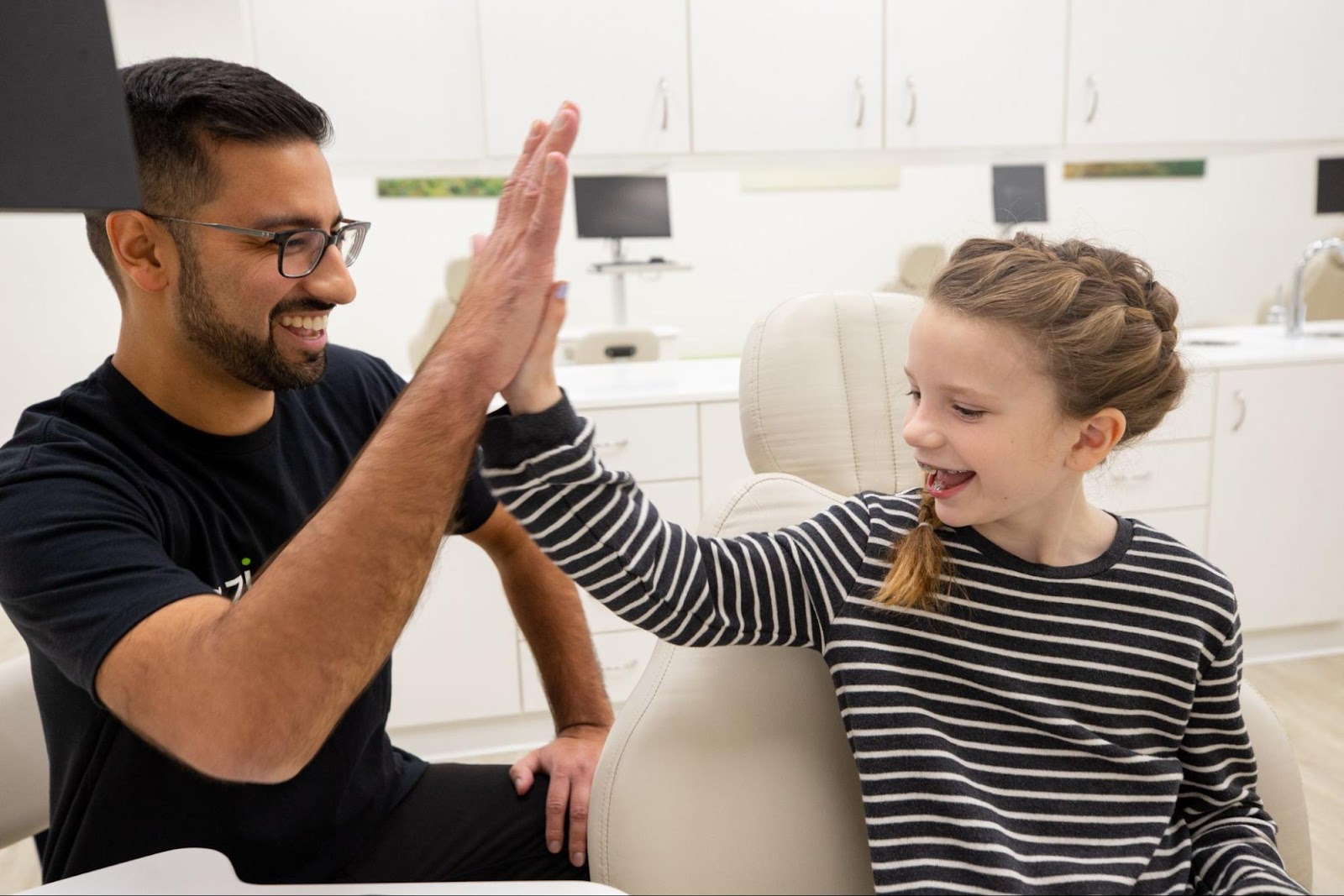
Children should first see an orthodontist by age 7, according to the American Association of Orthodontists. By this age, enough permanent teeth have come in for Dr. Razi, DMD, MSD, a board-certified orthodontist, to spot developing concerns like crowding, crossbites, or jaw growth issues. This early visit is an evaluation, not always the start of treatment. In fact, most kids won’t need braces right after their first visit, which is something many families across our community are relieved to hear.
So why go so young? Because catching small things early gives your friendly orthodontist the chance to monitor your child’s growth and step in at exactly the right time, if needed at all. Many children leave their first visit with nothing more than a follow-up plan to check back in a year or two. That peace of mind is a big part of what makes families part of the Razi Orthodontics family.
How an Early Orthodontic Evaluation Works
An early orthodontic evaluation is a short, low-pressure visit where Dr. Razi examines your child’s tooth eruption, jaw growth, and bite alignment. The American Association of Orthodontists recommends this checkup by age 7, and at Razi Orthodontics, the initial evaluation is included at no charge. Most kids leave with a simple monitoring plan, not braces.
Here’s what typically happens during that first visit:
- A friendly welcome. Our team introduces your child to the office, explains what we’ll be doing, and answers any questions you both have.
- A gentle exam. Dr. Razi checks how baby teeth are falling out, how permanent teeth are coming in, and how the upper and lower jaws fit together.
- Digital records. If needed, we’ll use our iTero Element digital scanner or take x-rays to see teeth still developing under the gums.
- A clear next step. Dr. Razi will share what he sees and recommend one of three paths: monitoring growth over time, starting two-phase treatment, or simply waiting until more permanent teeth come in.
For most children, the answer is watchful waiting. We’ll schedule periodic growth checkups (usually every 6 to 12 months) to track how things are progressing. If a smaller concern could become a bigger one later, Dr. Razi may recommend two-phase treatment to address it while the bones are still flexible and growing.
What Are the Benefits of Seeing an Orthodontist Early?
Seeing an orthodontist by age 7 lets Dr. Razi guide jaw growth, create room for permanent teeth, and correct harmful habits before they become harder to manage. Bringing your child in early doesn’t mean braces are coming soon. It simply gives Dr. Razi the chance to catch things early, when they’re easier to address. Here are some of the biggest benefits:
- Guides jaw growth. While your child’s bones are still developing, gentle guidance can help the upper and lower jaws grow in better proportion.
- Creates room for permanent teeth. If teeth look like they’ll be too tight, early care can help open up space so adult teeth come in straighter.
- Can reduce the need for extractions or jaw correction later. Addressing growth concerns early sometimes means fewer interventions in the teen years.
- Corrects harmful habits. Persistent thumb sucking or mouth breathing can shift teeth and jaws over time. Early visits help catch and correct these habits.
- Lowers risk of injury. Front teeth that stick out are more likely to get bumped or chipped during sports and play. Early care can help bring them into a safer position.
Beyond the clinical wins, there’s also a confidence boost. Kids who feel good about their smile tend to smile big, and that’s exactly what we love to see in families across Wheaton and Naperville.
Should My Child Get Early Treatment or Wait Until the Teen Years?
Whether your child needs early treatment or should wait depends on what Dr. Razi finds during the evaluation. Some children benefit from two-phase treatment to guide jaw growth and bite development, while others do just fine waiting until all their permanent teeth come in for a single round of care. The evaluation is what tells you which path fits.
One of the most common questions families ask is whether their child needs treatment now or if they should wait. Some kids benefit from two-phase treatment, while others do just fine waiting until all their permanent teeth come in.
Two-phase treatment splits care into two shorter stages:
- Phase 1 (ages 6-10): Focuses on jaw and bite development while bones are still growing. This phase often uses simple appliances or partial braces and typically lasts 6-12 months.
- Phase 2 (ages 11+): Aligns the full set of permanent teeth, usually with modern metal braces or Invisalign.
For many children, watchful waiting works perfectly well. Dr. Razi monitors growth, and treatment starts later as a single phase once most permanent teeth have erupted.
Here’s a quick side-by-side look:
| Factor | Early Treatment (Phase 1) | Waiting Until Teen Years |
|---|---|---|
| Typical age | 6-10 years old | 11+ years old |
| Main goal | Guide jaw growth, create space, correct bite issues | Align full set of permanent teeth |
| Treatment length | 6-12 months | 12-24 months |
| Best for | Crossbites, severe crowding, protruding teeth, harmful habits | Standard alignment and bite correction |
| Common appliances | Expanders, partial braces, space maintainers | Modern metal braces, Invisalign |
The right choice is the one that fits your child. That’s why we offer a free consult, so you’ve got options and a clear plan before making any decisions.
What Affects the Cost of Early Orthodontic Care?
The cost of early orthodontic care depends on a few key factors: whether your child needs active treatment or just monitoring, the type of appliances used, and your insurance coverage. At Razi Orthodontics, the initial evaluation is included at no charge, so you can get answers without any commitment. Phase 1 treatment typically costs less than a full set of braces.
Here’s what generally influences the total cost:
- Whether treatment is needed at all. Many children just need monitoring visits, which we provide at no charge.
- Type of appliance. Simple space maintainers cost less than expanders or partial braces.
- Treatment complexity. A short Phase 1 designed to correct a specific concern is usually less involved than two-phase or full treatment.
- Insurance benefits. We’re in-network with most dental insurance, and many plans include orthodontic coverage for children.
- Payment plans. Flexible monthly options make affordable care easier to fit into your family’s budget.
There’s also a long-term consideration. Catching certain things early often means fewer appliances and shorter treatment later on. A crossbite corrected at age 8, for example, can spare a child a longer round of braces and a more involved bite correction as a teen. While every smile is different, investing in an early evaluation regularly leads to simpler, lighter care as your child grows.
What Signs Suggest My Child Should See an Orthodontist?
Certain signs, like early or late tooth loss, difficulty chewing, mouth breathing, or crowding, suggest it’s worth scheduling an evaluation with Dr. Razi. Not sure if your child should come in for a free consult? Here are common signs that point to a visit:
- Early or late loss of baby teeth. If your child loses baby teeth before age 5 or still has many baby teeth past age 7, it may signal a developmental concern.
- Difficulty chewing or biting. Trouble eating certain foods or biting cleanly through them can point to a bite issue.
- Mouth breathing. Persistent mouth breathing, especially during sleep, can affect jaw growth and tooth alignment over time.
- Thumb sucking past age 5. Long-term thumb or finger sucking can shift teeth forward and change how the jaws develop.
- Jaws that shift or click. If you hear popping sounds or notice your child’s jaw moving to one side when biting, the bite may be off.
- Crowded or blocked-out teeth. Teeth that don’t have enough room often look twisted or stuck behind others.
- Biting the cheek or roof of the mouth. This often means the upper and lower teeth aren’t lining up the way they should.
- Facial imbalance. If one side of your child’s face or jaw looks noticeably different from the other, an evaluation can help.
If any of these sound familiar, it doesn’t necessarily mean braces are needed. It just means it’s a good time to find your perfect fit with a quick checkup.
Frequently Asked Questions
What age should my child first see an orthodontist?
The American Association of Orthodontists recommends that children have their first orthodontic checkup by age 7. By this age, enough permanent teeth have come in for Dr. Razi, DMD, MSD, a board-certified orthodontist, to spot any developing concerns. If everything looks healthy, we’ll simply monitor your child’s growth at no charge.
Does my child need braces at age 7?
Probably not. Most children who come in for their first evaluation don’t need braces right away. The visit is meant to check tooth and jaw development, not to start treatment immediately. If braces or another appliance would help, Dr. Razi will explain why and when the best time to start would be.
What happens at the first orthodontic visit?
The first visit is short, friendly, and pressure-free. Dr. Razi looks at your child’s teeth, jaw, and bite, takes any needed digital records, and shares what he sees. You’ll leave with a clear plan, whether that’s monitoring, starting Phase 1, or waiting for more permanent teeth.
Is early orthodontic treatment necessary?
That varies from child to child. Some kids benefit from early treatment to guide jaw growth or correct bite issues while bones are still developing. Others do just fine waiting until their teen years. The only way to know is through an evaluation with your friendly orthodontist.
How much does a child’s orthodontic evaluation cost?
At Razi Orthodontics, the first consult is completely free. There’s no cost to find out whether your child needs treatment now, later, or not at all. We think families deserve clear answers before making any decisions about care, and Dr. Razi takes the time to explain every option in plain language.