
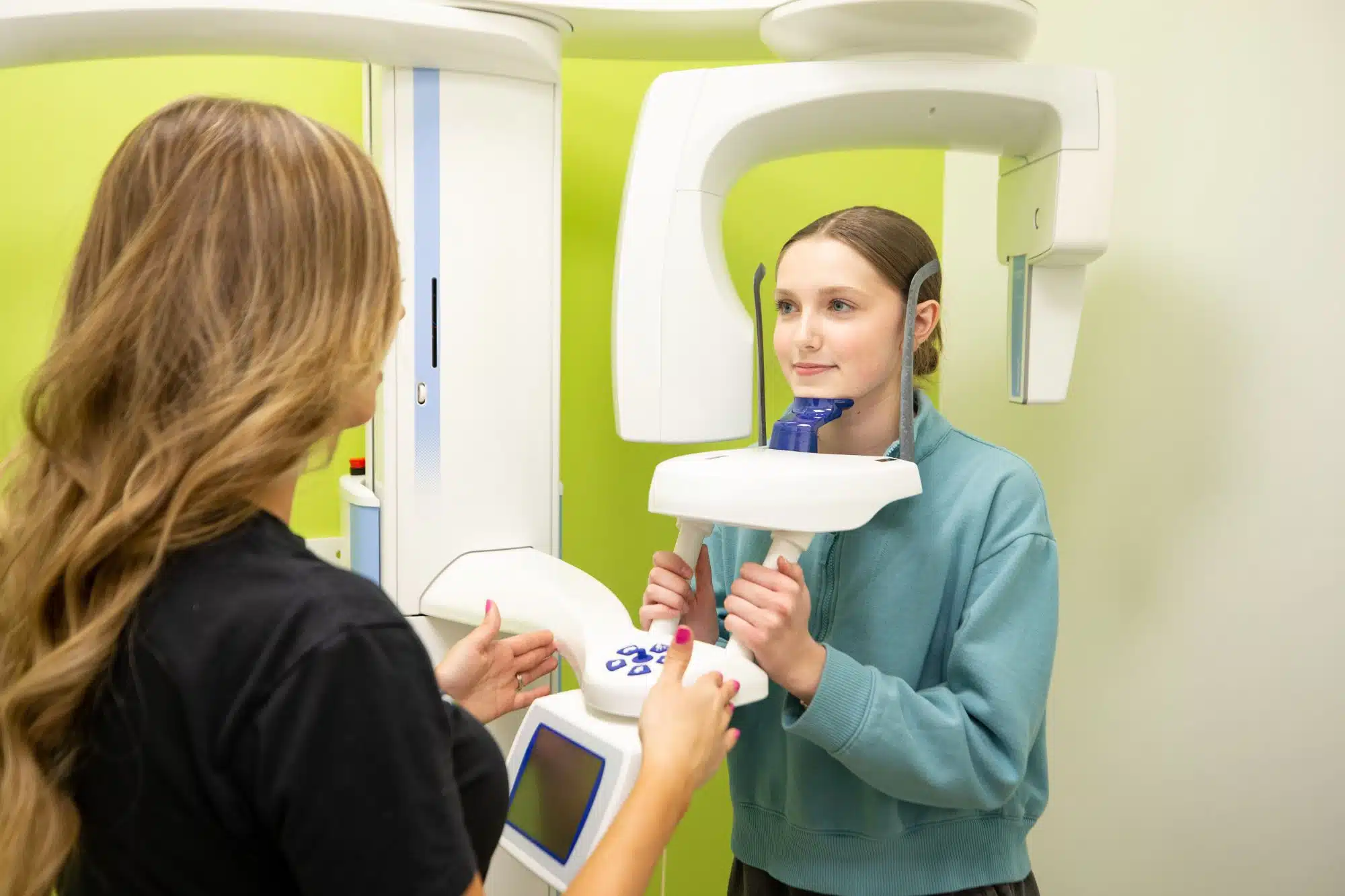
If an adult tooth has not appeared long after its match on the other side, it may be impacted, blocked by crowding, or missing. An orthodontic x-ray exam shows which, and early guidance is usually simpler than later correction.
How do you know a tooth is not coming in normally?
Symmetry is the simplest signal
Adult teeth generally erupt in pairs within a few months of each other. A tooth that has not appeared six months or more after its opposite number is the most common reason families get referred.
Other signs parents notice
- A baby tooth that will not loosen while the neighboring teeth have changed over
- A gap that is closing as neighboring teeth drift into the space
- A tooth erupting through the gum in the wrong position, high or off to the side
- Swelling or tenderness over an area with no visible tooth
- A tooth that looks smaller or cone-shaped, which can accompany missing teeth elsewhere
Why the exam has to include x-rays
Nothing above proves what is happening under the gum. Imaging shows whether the tooth exists, where it is pointed, how much room it has, and whether it threatens the roots of neighboring teeth. That is the whole reason for the AAO’s age 7 screening recommendation.
What causes an adult tooth to become impacted?
Common contributors are crowding that leaves no path for the tooth, a baby tooth that has not resorbed, an unusual eruption angle, extra teeth, or a cyst or growth blocking the path. Upper canines and second premolars are the teeth most often involved after wisdom teeth.
What are the treatment options?
| Situation | Typical approach | Why |
|---|---|---|
| Crowding blocking eruption | Create space with expansion or selective baby-tooth removal | Gives the tooth a path before it goes off course |
| Retained baby tooth | Remove it and monitor eruption | Often all a healthy adult tooth needs |
| Impacted tooth that will not erupt | Surgical exposure plus a chain or attachment, then guided into place with braces | Brings the tooth into the arch instead of losing it |
| Tooth is congenitally missing | Hold or close the space, plan for an implant or bridge later | Depends on the bite, age and the plan with your dentist |
| Tooth damaging neighboring roots | Prompt intervention with the oral surgeon | Root damage is not reversible |
Space management in a growing child often uses the same tools as routine treatment. Our guides to palate expanders and Phase 1 treatment explain how that works.
What does guided eruption involve for a child?
The surgical exposure
An oral surgeon uncovers the tooth and bonds a small attachment with a chain to it. The visit is done with anesthesia appropriate to the child, and recovery is typically a few days of soreness.
The orthodontic part
Braces are placed so there is a stable framework to pull against, and the tooth is moved along a planned path over months. Progress is checked with periodic imaging. This adds time to treatment, which is worth knowing when reading typical treatment timelines.
What families should expect day to day
Normal brushing, normal school, and appointments that are usually short. The main thing asked of families is consistency: missed visits stall a tooth that is mid-journey.
What happens if a missing or impacted tooth is ignored?
- Neighboring teeth drift and tip into the space, making later restoration harder
- The bite shifts on that side and can affect the opposite arch
- An impacted tooth can damage the roots of the teeth next to it
- Options narrow with age – guided eruption is far more predictable in a growing child
None of this is an emergency, and none of it is a reason to panic about a late tooth. It is a reason to get the x-ray rather than wait another year.
What does the diagnostic workup involve?
Clinical exam first
Your orthodontist checks which teeth are present, which baby teeth are retained, how much space exists, and whether the bite has already shifted on that side.
Imaging
A panoramic x-ray shows whether the tooth exists and roughly where it sits. When the position is unclear or roots of neighboring teeth may be at risk, three-dimensional imaging is used to see the angle and contact precisely. Imaging decisions are made case by case, not routinely.
The plan is written with the other clinicians
Guided eruption involves an oral surgeon, and a missing tooth involves your general dentist and possibly a restorative specialist later. Agreeing on space and timing at the start prevents rework, and our note on who handles what explains the roles.
Monitoring is a legitimate plan
For some children the right next step is a recall in six to twelve months with new imaging. That is an active decision with a review date, not a wait-and-see.
How can parents help during treatment?
- Keep appointments on schedule – a tooth being guided into place stalls when visits slip
- Watch hygiene around the attachment and the wire, where plaque collects
- Report loose attachments or chains the same week, not at the next visit
- Expect a longer course than routine alignment, and plan school and sports around visits
- Ask for the timeline in writing so everyone is working from the same expectations
Families who understand why the tooth is being moved slowly tend to stay consistent, and consistency is what makes guided eruption work. Local families can start with a visit at either office – see braces for kids in Wheaton.
Which teeth are most often affected, and why?
Upper canines
After wisdom teeth, upper canines are the teeth most likely to become impacted. They travel a long path from high in the jaw and erupt relatively late, so a lack of space or an off-course angle has plenty of opportunity to derail them. They are also worth rescuing: the canine carries the corner of the smile and takes heavy bite forces.
Second premolars
These erupt into space that crowding often takes first. When a baby molar is lost early or neighboring teeth drift, the premolar underneath can end up blocked or tipped.
Lower second molars
Occasionally these tip backward and fail to erupt fully. They are easy to miss, because nothing looks wrong from the front, and they are typically found on a routine x-ray.
Teeth adjacent to an extra tooth or a cyst
When something occupies the eruption path, the tooth stops. Removing the obstruction early often lets eruption resume with little or no orthodontic help – the best outcome available and the reason timing matters so much.
How long does guided eruption take, and what does it cost in visits?
Bringing an impacted tooth into the arch is measured in months, not weeks, because the tooth is moved slowly enough to protect the bone and the neighboring roots. Families should expect the surgical exposure, then regular orthodontic visits through the movement phase, then normal alignment and finishing once the tooth is in the arch.
Because the sequence involves an oral surgeon and the orthodontist, ask at the consultation how the appointments interleave and what the insurance picture looks like for each part. Our financing and insurance page explains how we handle the orthodontic side.
Frequently asked questions about impacted and missing teeth
How late is too late for an adult tooth to come in?
There is a normal range for every tooth, so the useful comparison is the same tooth on the other side. Six months of asymmetry is a reasonable point to have it checked.
Can an impacted tooth be left alone?
Sometimes, with monitoring, if it is not damaging anything. That is a decision made from imaging and reviewed over time, not a one-time call.
If a tooth is missing, will my child need an implant?
Possibly, and implants are placed after growth is finished. In the meantime the orthodontic job is to preserve or close the space so the later restoration is straightforward – planned together with your general dentist.
Does this mean my child needs braces twice?
Not always, but two stages are common when early space work is done during growth and alignment is finished later. See Phase 1 versus Phase 2 treatment for how the stages differ.
Have a late tooth checked in Wheaton or Naperville
Dr. Kaleem Razi, DMD, MSD, evaluates eruption, spacing and timing for children at Razi Orthodontics – part of orthodontic care for all ages. Call (630) 614-1162 or request a free consultation at our Wheaton or Naperville office.